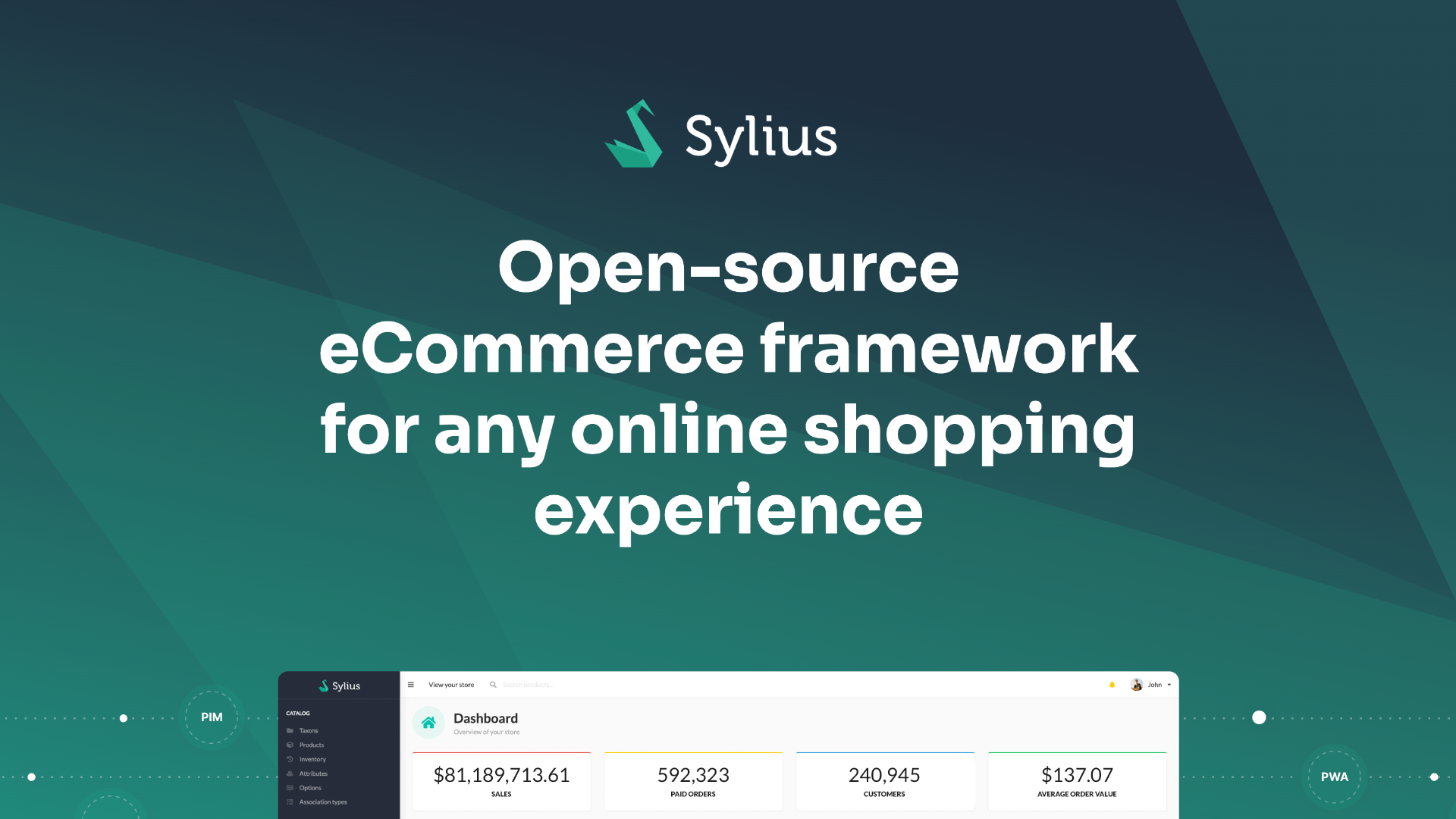
Sylius is an optimal choice for mid-market and enterprise developer teams seeking a customizable, open-source Symfony framework for bespoke headless B2B and B2C commerce. It is not suitable for non-technical store owners wanting a no-code, turnkey platform, as setting up and operating the software demands skilled PHP engineers. If your organization possesses dedicated development resources and needs an API-first engine without platform revenue-sharing fees, Sylius offers enterprise-grade architectural freedom.
| Feature | Sylius Overview |
|---|---|
| Platform Type | Open-source headless eCommerce framework |
| Core Framework | PHP, Symfony, API Platform |
| Licensing | MIT License (Community Edition) |
| Commercial Edition | Sylius Plus (custom quote) |
| Deployment | Self-hosted (VPS, Docker, Kubernetes) |
- Sylius provides an open-source, MIT-licensed Community Edition alongside commercial Sylius Plus modules.
- Sylius relies entirely on a modern PHP stack built on Symfony and API Platform for headless setups.
- Sylius requires dedicated software engineering, as it is a development framework rather than a turnkey store builder.
- Sylius scales across over 10,000 stores globally, backed by an ecosystem of over 500 indexed marketplace addons.
- What is Sylius and who should use it?
- How much does Sylius cost and what are the plans?
- What are the main strengths and limitations of Sylius?
- How is Sylius rated by users across review platforms?
- FAQ
- Is Sylius open source?
- Is Sylius free?
- What technology is Sylius built with?
- Can Sylius handle B2B commerce?
What is Sylius and who should use it?
Sylius is a modular, open-source headless ecommerce platform engineered for tailored online retail experiences. Built entirely on the Symfony PHP framework and API Platform, Sylius separates backend ecommerce logic from the frontend presentation layer. Organizations with specialized business workflows, multi-channel footprints, or internal technical expertise benefit most from Sylius compared to prepackaged monolithic site builders.
- Sylius is best for mid-market and enterprise businesses with in-house PHP or Symfony development teams.
- Sylius is ideal for digital agencies creating custom, bespoke commerce architectures that deviate from standard template shops.
- Sylius suits brands seeking an open-source, API-first headless foundation under European GDPR jurisdiction.
- Sylius is not recommended for non-technical merchants looking for a no-code, turnkey hosted platform.
- Sylius is not suitable for teams lacking dedicated Symfony developers to oversee hosting, deployments, and codebase maintenance.
How much does Sylius cost and what are the plans?
Sylius Community Edition is entirely free and open source under the permissive MIT license, carrying zero platform license fees. Sylius Plus is the paid commercial tier aimed at mid-market and enterprise merchants requiring pre-built enterprise extensions. Licensing fees for Sylius Plus are not publicly listed and require a custom quote from the vendor based on project scope and modules selected.
| Plan | License Type | Pricing |
|---|---|---|
| Sylius Community Edition | Open Source (MIT) | Free |
| Sylius Plus | Commercial Proprietary | Custom quote (verify with the vendor) |
Our analysis indicates that your total cost of ownership depends largely on engineering and infrastructure. Because Sylius is self-hosted on your own virtual private servers, Docker instances, or Kubernetes clusters, merchants must fund independent hosting environments, security patches, performance scaling, and ongoing PHP development.
What are the main strengths and limitations of Sylius?
Sylius excels at backend flexibility, code quality, and developer ergonomics, but it introduces high technical overhead. While platforms like WooCommerce provide off-the-shelf admin setups with visual builders, Sylius targets organizations that treat their ecommerce platform as custom software.
| Strengths | Limitations |
|---|---|
| Clean Symfony architecture built with Behavior-Driven Development (BDD) | Requires skilled PHP/Symfony developers to build, launch, and customize |
| Fully headless and API-first design via API Platform for any frontend | No native SaaS offering; all hosting and maintenance rest on the merchant |
| MIT license guarantees full data ownership with zero revenue-share cuts | Sylius Plus enterprise pricing is opaque and quoted per project |
| Advanced modular add-ons for B2B, marketplace, and inventory logic | Ecosystem of pre-made templates is smaller than turnkey alternatives |
For specialized scenarios, Sylius offers targeted commercial configurations. Sylius provides Elesto as a preconfigured B2B setup for manufacturers and wholesalers, as well as Dafre, which incorporates multi-vendor logic for digital marketplaces. Sylius Plus also adds dedicated modules including Multi-source inventory, Returns Management (RMA), a Loyalty system, Partial shipment, Role assignment, and One Page Checkout.
How is Sylius rated by users across review platforms?
Sylius maintains positive ratings across major software directories for its architectural standards and developer community support. Feedback highlights praise for its automated testing conventions and extensibility, balanced by notes regarding its steep initial engineering requirement.
| Source | Rating | Review Count |
|---|---|---|
| 4.8 / 5 | 2,846 reviews | |
| Capterra | 5.0 / 5 | 11 reviews |
| G2 | 4.0 / 5 | 6 reviews |
According to official metrics from sylius.com, the platform powers over 10,000 online stores worldwide. The community ecosystem encompasses more than 7,400 Slack community members, 700 contributors, 77 agency partners, and over 500 extensions listed in the official Sylius Addons Marketplace.
FAQ
Is Sylius open source?
Yes, Sylius Community Edition is fully open source and published under the permissive MIT license.
Is Sylius free?
Sylius Community Edition is free to download, self-host, and modify, while the enterprise tier, Sylius Plus, requires a paid commercial license based on a custom quote.
What technology is Sylius built with?
Sylius is built with PHP on top of the Symfony full-stack framework and utilizes API Platform to deliver its headless REST and GraphQL interfaces.
Can Sylius handle B2B commerce?
Sylius supports complex wholesale workflows through Sylius Plus B2B Suite modules as well as Elesto, a preconfigured setup tailored for manufacturers and wholesalers.
Sources & Method: Data aggregated from the official platform site (sylius.com), developer profiles on European Purpose, Gappsy, and Google Search. Review metrics from Google, Capterra, and G2 as shown in Google and Bing search results on 2026-11-02. This review is for analytical purposes and does not constitute personalized technical consulting or financial advice; verify commercial licensing directly with vendors.
Related reading:
Need help with WooCommerce? Discover platform migration guides and architectural comparisons on woocommercealternatives.com. For complex builds, migrations, and performance optimization, connect with our vetted engineering partner, Elogic Commerce.